Wednesday, June 06, 2007

Optimizing the Kolb Learning Model

by:
Gary J. Salton, Ph.D.

FORWARD

The Kolb learning model (Kolb & Fry, 1975) is the dominant paradigm in adult learning. It holds this position because it is a practical, easily understood taxonomy that works to an acceptable degree in field settings.

Kolb has its limits. Most importantly, it is based on psychology—the science of the individual. Most instruction occurs in a classroom setting. This is the realm of sociology—the science of groups. Kolb provides no set way of getting from the individual to the group. This is a serious shortfall for those interested in large scale training efforts.

This research blog estimates the size of the shortfall. Data was collected from 185 actual adult classes involving 3,116 individuals in 5 different organizations. Classes were held in cities in the United States, Asia and Europe. While not random, the sample is broad enough to suggest a level of credibility.


"I Opt" technology was applied to the data to bridge the psychology-sociology gap. "I Opt" is a theoretically founded, fully validated and tested knowledge base (see www.oeinstitute.org
for "I Opt" theoretical underpinnings or www.iopt.com for operational tools). "I Opt" is an information-processing tool. Since information processing is common to both individuals and groups is a natural bridge between the individual and group.

ALIGNING THE KOLB MODEL

Both Kolb and "I Opt" use a four-axis model. Each axis of the "I Opt" model is a combination of input and output elections. Some of the behaviors produced by these interactions can be seen as the "orientations" that Kolb uses in his taxonomy (i.e. classification system). In other words, the Kolb conceptual model can be seen as a subset of the broader "I Opt" paradigm.

GRAPHIC 1 KOLB LEARNING MODEL AND "I OPT" GRID


Graphic 1 contrasts Kolb and "I Opt". Kolb is a conceptual scheme whereas "I Opt" is a measurement grid. The axes on the "I Opt" model are called "styles" whereas Kolb calls his conceptual variables "stages." The difference is more than just names. Kolb's model rests on MBTI psychology. There is no way to measure his stages except by asking people for their subjective assessment. There is no way to know if what one person means by "sometimes" is the same as what another person means. You can add Kolb's scores but you could be adding apples and oranges. You would never know.

The "I Opt" input and output elections are measured on an absolute rather than subjective scale. The absolute scale is what allows the elections of individuals to be combined into groups. This ability to "add up" people is what gives "I Opt" the power to bridge the individual-group gap.

"I Opt" can combine its style "building blocks" to produce different things (see here for list) . For example, the "I Opt" Hypothetical Analyzer style uses structured input and thought (conceptual) output. Structured input (a method that uses some form of reasoning to select input) combines with conceptual output (logical combination of particulars). This produces systems, theories and explanations. These products are all various levels of abstraction and are roughly consistent with Kolb's abstraction category. Kolb's other conceptual variables can be similarly derived from the "I Opt" model.

The match between "I Opt" and the Kolb is not perfect. However, it is sufficiently aligned to allow the data collected within an "I Opt" framework to be applied to the Kolb model.

MEASURING THE STRENGTH OF KOLB’S STAGES

Kolb sees a circular or spiral sequence of stages. Without measurement Kolb's model cannot tell you how much emphasis to give each stage. Rather, he suggests "touching all the bases." Without measurement there is no way of defining how hard the bases are to be "touched." Applying "I Opt" measurements from 3,116 people allows us to define what Kolb cannot.

GRAPHIC 2
KOLB’S “CONCRETE EXPERIENCE” AND “NEW SITUATIONS” VARIABLES
Percent of Students at Various Commitment Levels: "I Opt" RI and RS Styles


Graphic 2 reveals that 81% of people do not heavily rely on the Concrete (1) or New Situations (4) stages ("I Opt" RS and RI styles). Fully 48% of people prefer very low levels. Instruction that exceeds these levels will appear irrelevant and difficult to assimilate.

GRAPHIC 3
KOLB'S "OBSERVE & REFLECT" AND "CONCEPTS" VARIABLES
Percent of Students at Various Commitment Levels: "I Opt" LP and HA Styles
Graphic 3 shows that Kolb's Observe & Reflect (2) and Concept (3) stages operate in almost the reverse fashion. Fully 42% of people would prefer medium-high to very high levels of this instruction. Falling short of this standard will leave people feeling inadequately prepared.

Graphic 4 shows a cumulative distribution of the four Kolb stages. Extending a line form a desired coverage level shows the level emphasis needed. The line on the graph shows that targeting of 75% coverage would require different emphasis on the various Kolb stages.

GRAPHIC 4 CUMULATIVE DISTRIBUTION OF KOLB VARIABLES
"I Opt" is not confined to Kolb's ordinal (e.g., low, medium, high) measures. The actual strength of each style (Kolb stage) in Graphic 4 can be measured. Graphic 5 shows a pie chart distribution of these strengths. Because the I Opt scores are not simple categories but rather are the result of information processing elections, the pie chart can also tell you how to design instruction in terms of input-output structure.

GRAPHIC 5
MINIMUM LEVELS OF KOLB STAGES TO CAPTURE 75% OF STUDENTS
Graphic 5 shows that the designer should give about equal attention to thought and action—the "how" and "why" of the subject. However, in terms of input a 60-40 rule seems optimal. About 60% of instruction should be structured—a “this causes that” or “do this, then do that” sequencing. This is knowledge in a firm framework.

The remaining 40% should be unpatterned input. This is more spontaneous and less predictable knowledge flow. It typically involves decisions by students. For example, students might be asked to provide examples of applications or be asked to apply the principles to a subject. Their choice of examples or methods of applying principles will vary. This is knowledge in a "fuzzy" framework.

HOW TO MEASURE KOLB LEARNING STYLES IN GROUPS

Kolb recognized that people learn by combining his stages. He calls these combinations of stages “learning styles.” These are shown as diagonals in Kolb’s basic model. I Opt also has diagonal interconnections. I Opt uses the term “patterns” to describe these interactions. Graphic 6 compares the two approaches. The parallels are obvious.

GRAPHIC 6
KOLB LEARNING MODEL STYLES AND "I OPT" GRID PATTERNS

Visual similarity does not mean identity. “I Opt” technology has exact measurement. The Kolb learning styles can never be measured. This is because the scales used for each stage do not have a common denominator. "I Opt" is different. Each axis has an input or output election in common with an adjacent axes. This commonality along with identical axis scoring methods means that diagonals can be quantified. This means learning styles can be measured exactly.

Graphic 7 shows how measurement is done. The profiles of two real individuals from the 3,116-person research base are shown in Graphic 7A. Deciding how to teach these two people together would be a challenge if you were limited to the Kolb taxonomy.

GRAPHIC 7
MEASURING LEARNING STYLES OF GROUPS

“I Opt” offers a solution. "I Opt" profiles are not mere illustrations. They are exact measurements of information processing preferences. They can be superimposed. This creates a “common area” that describes an information flow acceptable to both people. The common area for Dave and Teresa is shown in white in Graphic 7B. The percentage of common (i.e., white) area in each quadrant describes the amount of that kind of instruction that will jointly serve the people involved. Clearly, touching all bases equally is a poor solution for this pair.

What can be done for 2 people can be done for an entire class. Graphic 8 shows the profile of the class in which Dave and Teresa participated. The gray area is the common area of a majority of the 16 people in the class (i.e., at least 9 people fall in every point in this area). This majority area is where most people share a common learning preference. If your purpose is to teach as many people as much as possible, this is majority area defines your optimal strategy.

GRAPHIC 8
LEARNING PROFILE OF AN ACTUAL CLASS

The yellow dots are in Graphic 8 are the centroids of each person in the class. A centroid is the single point that best represents a person’s whole profile (i.e., Cartesian Average). Centroids help give a quick picture of how individual people fit into the group as a whole. For example, this one shows that both Dave and Teresa are likely to be a bit dissatisfied with the group strategy. This is another advantage of “I Opt.” You can see who will need to be compromised and by how much in order to serve most people in the class. Taxonomies can never give this kind of information.

THE “TYPICAL” CLASS

Individual classes vary widely in their learning preference. Graphic 9 shows a random selection drawn from the 185 classes in which the 3,116 people used in this research participated.

GRAPHIC 9
KOLB LEARNING STYLE SAMPLE OF ACTUAL CLASSES

Actual classes conducted within the 185 class sample


All classes have at least some representation in each learning style (i.e., I Opt pattern). This means that almost any teaching strategy will work to some degree. However, the differences between classes illustrate that no instructional strategy that will optimize all of them. What ever you do will be a compromise. The issue is whether your compromise is optimal.

INSTRUCTIONAL DESIGN OPTIMIZATION
Instructional Designers are concerned with optimizing the learning of groups, not individuals. This means focusing on the learning styles (rather than stages) of the actual classes that will be taught. Graphic 10 shows the distribution for each of the four learning styles among of 185 classes measured in this research.

GRAPHIC 10
KOLB LEARNING STYLE DISTRIBUTIONS
Applied to the profiles of 185 classes
Graphic 10 also shows the midpoint of the each of the Kolb learning styles (i.e., "I Opt" Patterns). The midpoint (median) is where half of the classes fall on either side. A strategy of targeting the midpoint would minimize the degree that a learning style will exceed or fall short in a typical class. Instruction designed to hit this point would minimize the deviation an instructor would have to adjust for in particular classes. It is a viable option.

Graphic 11 compares the "touch all styles equally" and the midpoint design strategy. There is a 70% overlap in the two learning profiles. However, it also shows that designers should plan to give about twice more instruction in the Assimilating (B) than the Accommodating (D) learning styles. The difference between a 70% and 100% overlap can mean a lot.

GRAPHIC 11
“TOUCH ALL BASES EQUALLY” VERSUS MIDPOINT STRATEGY
Based on 185 Classes
This blog uses a large and diverse research population. However, the other blogs in this series show that there can be systematic differences by firm, function or organizational level. The safest course in designing instructional policy is to sample the actual population being taught and use it as a standard. In final analysis there is no substitute for exact measurement.

SUMMARY

The research has also shown that improvement in the Kolb model is possible. "I Opt" technology allows its concepts to be extended to groups. It can be used to measure the systematic biases in their learning preferences. It can show you exactly which individuals will be "short changed" when using an instructional design that is best for the group. Finally, it illustrates that reconciling psychology and sociology can magnify the reach and power of the learning professional.


BIBLIOGRAPHY
Kolb. D. A. and Fry, R. (1975) 'Toward an applied theory of experiential learning', in C. Cooper (ed.) Theories of Group Process, London: John Wiley.

Sunday, April 15, 2007

Structural Barriers to Change and Innovation in Nursing

by:
Beatrice J. Kalisch, Ph.D., RN, FAAN, Titus Professor of Nursing, University of Michigan
Suzanne Begeny, MS, RN, Ph.D. Applicant, University of Michigan

FOREWORD
This blog is based on an article published in the peer-reviewed academic journal Nursing Administration Quarterly in October/December 2006 (Vol. 30, No. 4, pp. 330-339). It is available for purchase at the journal’s website under the title Nurses Information Processing Patterns: Impact on Change and Innovation. This blog summarizes and extends the findings reported in that article. Information on the “I Opt” tools used can be found on www.iopt.com. Information on the intellectual underpinnings of “I Opt” technology can be found on www.oeinstitute.org.


INTRODUCTION
The focus of this research was the ability of nurses to accept, adopt and sponsor change in an era of high volatility in health care. The research was conducted at two geographically separated hospitals and involved a total of 578 nurses.

The research drew on the fully validated “I Opt” instrument that measures information processing preferences. It is based on the simple idea that the kind of information sought and accepted from the environment limits or facilitates certain types of behavior. For example, if you do not pay attention to detail, your responses cannot be precise. It does not matter how you "feel" about it. Similarly, if you choose to rigorously apply well-understood methods, you foreclose your ability to discover new, groundbreaking things. Closely following established methods blinds you to unexpected options. By governing the knowledge available a person’s "I Opt"
(Input-Output-Processing-Template) profile systematically governs the behavior that can and will appear.


FINDINGS

The study was designed to address specific hypothesis with a high degree of academic rigor. Statistical significance testing used the academically accepted standard of p<.05 (95% probability that the result was not due to chance) or better. In the journal these findings are presented in a standardized academic format. Here they are presented in an operationally accessible manner more useful to executives and managers who are positioned to make use of them.


Finding 1: Nurses Differ Markedly from Non-Nurses
Nurses were compared to other functional areas. These areas included:

Customer Service Personnel (n=599)

Hourly Industrial Workers (n=71)

Plant Operations Management (n=593)

School Teachers (n=608)

Engineers (n=945)

Scientists (n=48)

Corporate Managers (n=721)


The findings indicated that nurses most closely resemble Customer Service Personnel. Customer Service is typically involved in authoritatively answering client questions by referring to approved information sources. There was no significant difference across all four “I Opt” Strategic styles between nurses and customer service personnel.


At the other extreme, nurses had significant differences along all four “I Opt” Strategic styles with Engineers, Scientists and Corporate Managers. These disciplines consistently scored higher in the unpatterned input strategies of Relational Innovator
(ideas) and Reactive Stimulator (decisive action) than their nursing counterparts. These are the adaptive styles that are able to initiate and accommodate change with relative ease.

In the middle zone, nurses were significantly less idea oriented
(RI) than schoolteachers and Plant Operations management. The nurses significantly exceeded these functions in disciplined action (LP). This suggests that these areas will find change and innovation more palatable than will nurses. Hourly Industrial workers significantly exceeded nurses in both disciplined action (LP) and analysis (HA) but equaled nurses in ideas (RI) and decisive action (RS).

The picture painted by this analysis is that nurses are among the least able to initiate and accept change among the functions reviewed. Their favored information processing strategy relies on certainty, precision and step-by-step operational knowledge. This posture forecloses information needed to initiate change
(unproven possibilities, unexpected associations, etc.) and accept it readily (e.g., a willingness to use tools that may not be fully specified).

Nurses can, of course, adapt to change. However, if the same methods as used for engineers, scientists and corporate managers are applied to nurses the road will be difficult. And, it will be difficult for everyone. Nurses are likely to feel emotional pain as they are forced out of their preferred approach to life. The sponsors of change will feel pain as they meet reluctance and resistance. Standard business school management strategies must be modified if they are to be fully effective in nursing situations.


Finding 2: Nursing Specializations are more Similar than Different
The nursing data identified the specialization within which the nurse respondents worked. These areas included:

Emergency Room
Surgical
OB/GYN
Telemetry
Ambulance
Psychiatric
Medical
Intensive Care

The results of the research showed that there was no statistically significant difference between specialties in the disciplined action (LP) or analytical (HA) strategic styles. This means that all specialties are about equally committed to structured approaches.

There was some variation in unpatterned strategies (RS/RI). Nurses in Intensive Care and psychiatric were more idea oriented (RI) than the others. This seems to make some sense in that these areas are most likely to encounter cases that do not yield to standardized approaches.

The other nursing specialties scored significantly lower in either decisive action (RS) or novel ideas and approaches (RI). For example, surgical was significantly lower in spontaneous decisive action (RS). Again this makes sense. The operating room is a hierarchical system functioning under the direction of the surgeon. There is little room for independent nursing action.

This area of research has an implication. The commonality of disciplined action (LP) and analysis (HA) means that all of the nurses can be successfully approached using the same methods. This means that a uniform change management can be applied. The efficiencies available in a common approach can be captured.


Finding 3: Staff Roles are Different

The data collected identified the organizational role of the individuals sampled. This allowed direct comparisons of staff roles.


The first comparison was between Registered Nurses (n=344) and Nurse Aides (n=101). The Nurse Aides registered statistically higher levels disciplined action
(LP). In all other dimensions the RNs exceeded levels of the Nurse Aides. This suggests that the difficulties with change and innovation extend down the organization. The RN’s reluctance to change will be magnified by the Nurse Aides who support them.

The RNs were then compared to Unit Secretaries (n=40). Like the Nurse Aides, the Unit Secretaries are significantly more committed to disciplined action
(LP) than are the RNs. This means that there is still another layer of potential resistance to change that regularly interacts with and influences the RNs.

Finally, RNs were compare to Licensed Practical Nurses. The LPNs were significantly more committed to disciplined action
(LP) than are the RNs. Still another layer of change resistance is added below the level of the RN.

The general sense arising from this portion of the analysis is that the difficulty in accepting, adopting and sponsoring change is even more difficult than it first appears. The nurses rest on an organizational support system that is even more reluctant to change than they are. Since these support functions interact constantly with the RNs, they are positioned to magnify the RNs basic disinclination toward change. A difficult job has become more difficult.


The implication of this finding is that change initiatives must be organizationally sensitive. They must understand that addressing the RNs is not the end game. They must also address the levels organizationally below the RN. They must also understand that the RN will face a challenge when they ultimately accept change. They must then turn around and “sell” it to their support staff. This is likely to be as difficult as “selling” the change to the RNs in the first place.


Finding 4: Nursing Managers are Different than RNs

Staff nurses in all specialties (n=344) were compared to Nurse Managers (n=52). The Nurse Managers had much higher levels of RI
(ideas) and RS (decisive action). Overall, they resemble the average manager in other functional areas of society.

The implication of this is that Nurse Managers faces a challenge in sponsoring and guiding change initiatives. They do not think like the people that report to them. If they follow the “golden rule” they will do unto the staff as they would have done unto themselves. If they do this, the result will fall far short of optimal. The average RN does not want to be treated like a manager. They are sensitive to different variables, have different standards and are comfortable in different environments.


An analysis done outside of this study suggests that Nurse Managers strongly resemble managers in other industries. But there is a difference. In other industries the staffs being supervised are more diverse. Diversity means that there is likely to be someone relatively near the manager’s posture who can interpret matters in a way others can understand and accept. This creates “emissaries” to help managers “sell” their ideas and postures to the larger staff.


Nurse Managers do not have this luxury. Their job is more difficult. As shown in the next section, they face a solid wall of likely resistance. This means that Nurse Managers will need to be taught to lead people who are very different from themselves. Standard business school management education applies but must be supplemented if Nurse Managers are to be fully effective.


DISCUSSION AND IMPLICATIONS

In addition to the distinctions cited above, another aspect of the nursing staff became visible in the course of the study. The nurses are tightly clustered. This condition is shown in Graphic 1. It shows the distribution of actual nurses in one section of a major hospital. It is representative of the general distribution encountered in both hospitals and across all areas.


GRAPHIC 1 DISTRIBUTION OF NURSING STAFF “I OPT” PROFILES BY SHIFT

Each dot on the graphic represents the centroid (point of central tendency) of the information processing profile a particular nurse. There is a clear clustering in the lower right hand quadrant. This is the “Conservator” pattern. It seeks to conserve or preserve things that are proven and known to work. People using it strive for excellence and precise execution. It is the information processing posture that has the most structural resistance to change.

The implication of this condition is that it magnifies the difficulty of change even further. The nurses are personally disinclined toward change and have a staff that is even more reluctant to change. In addition, there is now a coalition factor. Nurses are likely to magnify their reluctance to change in there interactions with each other. The tight clustering means that they tend to think alike and will see much merit in each other’s judgments. A very difficult job has just been made more difficult.


The overall picture painted by this research and outlined in this blog is that Change Management in nursing will present a unique challenge to all involved. The internal capacities of a hospital are likely to require external support if success is to be enjoyed. A possible general framework for approaching change in a hospital environment might be:


A PLAN FOR INITIATING CHANGE IN HOSPITALS

1. Clearly define the goals of the change initiative and the areas of the hospital affected.

2. Collect “I Opt” Survey data for all levels of the areas affected—from executives to Nurse Aides. There is no substitute for exact measurement of the current condition.


3. Plot and analyze the “I Opt” findings. Assess the difficulty likely to be encountered by areas affected. Develop an overall plan to initiate the change that will be common to all areas. Develop sub-plans that will address unique aspects discovered in the analysis.


4. Initiate context specific Leadership training for all managers affected. This is not generalized “Leadership” instruction. Rather each leader will be trained to guide the specific group for which they are responsible. This is performance based training rather than developmental. Tools like “I Opt” LeaderAnalysis™ can be used to support this process.


5. Apply the generalized program created in Item 3 above to the RNs and their staffs. Create and apply supplemental training appropriate to the education and role of each staff category
(e.g., RN, LPN, NA, US). Use the data collected in Item 2 above to design the supplemental material to exactly target the people involved.

6. Initiate a team based program to support the effort. This will help mitigate the coalition effects by focusing the people involved on their immediate interests and responsibilities. Tools like “I Opt” TeamAnalysis™ can be applied to initiate the effort.


7. Expect this process to take time. The Logical Processor style can and will change. But their information processing style demands a linear, step-by-step, exacting approach. The global Change Management programs currently popular in other industries are unlikely to yield any enduring gains.


8. If money is an issue, consider a viral strategy. Implement the above program in a relatively narrow area. People in other areas will see the success. At minimum, this will cause them to be more amenable to accepting the program. At best it will cause them to demand that they also get the benefits of the program. In this implementation the program is designed to act as a virus “infecting” other parts of the hospital in a positive manner.


SUMMARY

This research has proven to be eye-opening. Specific measurement has replaced opinions. Fully grounded, validated tools have replaced “on the fly” surveys. A well-defined “what causes what and why” theory has displaced speculative guesses. Most importantly, “I Opt” technology actually works when it is used in field settings. It is an excellent mix of academic rigor and operational utility.


One mark of productive research is that it gives rise to more questions. This was the case here. As a result of this study we are now involved in another study. This study will trace the causes and implications of the high level of commonality found among the nurses. Even at this point we are able to see the outlines of the system that has created the current condition. But for now, the above is a step in the right direction.


Sunday, January 21, 2007

Human Resources VP’s “Seat at the Table”

by: Gary J. Salton, Ph.D.

This blog addresses the match between HR executives and the other executives participating at the highest levels of firms. The goal is to identify an objective and observable condition(s) that influence the ability of the HR executive to get and keep a “seat at the table.” In other words, to participate in setting the policy and strategy of a firm.

This study finds that there is a systematic difference between HR executives and other executives who already have a “seat at the table.” The consequence of this difference negatively impacts HR’s ability to consistently contribute to corporate policy and strategy.

The investigatory tool is a database of the information processing preferences of people at all organizational levels (n>30,000). This base contains exact quantitative measurements based on “I Opt” technology. The “I Opt” tool is thoroughly outlined at www.iopt.com. Its theoretical and operational foundations are addressed at www.oeinstitute.org. It is a well-tested, fully validated tool that yields reliable measurements.


HOW DIFFERENT ARE HR EXECUTIVES IN SHORT-TERM POSTURES?

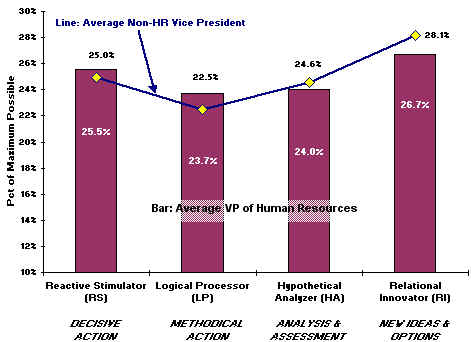
I Opt” STRATEGIC STYLES measure the short-run decision preferences. In other words, what is the most likely behavior on the next decision that a person is likely to make? Chart 1 compares 26 VPs of Human Resources to an average of 207 VPs of other functions.

CHART 1
VICE PRESIDENT COMPARISON: HR versus OTHER FUNCTIONS

Strategic styles describe behaviors arising from the input-process-output elections of a person. For readers not familiar with “I Opt” technology, these can be crudely typified (but are not defined) by the italicized descriptors below each bar in Chart 1.

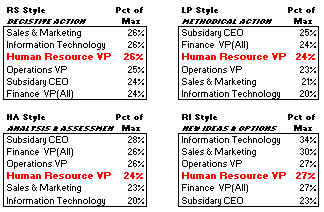
The HR VP “fits” into the overall posture of the other executives with whom they must deal “at the table.” This is confirmed by looking at the executive groups in detail. Table 1 shows the average scores of the executive groups for each strategic style.

TABLE 1
FUNCTIONAL VP MEAN SCORES BY STRATEGIC STYLE

HR is positioned in the middle of the group in all cases. A t-Test (parametric) and the Mann-Whitney U test (non-parametric) were used to determine if the mean scores were statistically different. Neither test found any statistically significant difference between HR and the other groups. In other words, senior HR executives “talk the same language” as their peers in their short-term information processing approach to issues.

There seems to be little reason to be excluded from “the table” on the basis of HR's short-term decision approach to issues. However, the focus of the “table” is not about short-term issues. It is about long-term positions and complex sequences of decisions.


THE LONG-TERM POSTURE OF HR IS DIFFERENT

“I Opt” STRATEGIC PATTERNS describe the long-term decision postures. Patterns rest on the idea most significant issues involve a series of decisions. It is very unlikely that every item in that series will respond to the same strategic style. People must shift. When they do, they tend to shift from their most favored to their next most favored style. The combination of primary (most favored) and secondary (next most favored) styles create the “I Opt” strategic pattern.

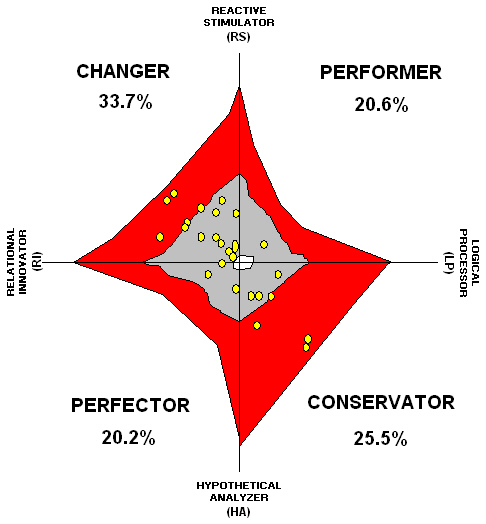
Strategic patterns are measured as the surface area of a quadrant bounded by adjacent strategic styles. This is visually represented in Graphic 1. The gray area of this graphic that depicts the preferred posture of the majority of VPs of HR. Over multiple decisions the HR VP would be seen as adopting an “great idea! Let’s try it ” stance (RI/RS). This is denoted by a “Changer” pattern. Anyone following this strategy would display a behavior pattern typified by change.

GRAPHIC 1
VICE PRESIDENT OF HUMAN RESOURCE STRATEGIC PATTERNS

The dots on the Graphic 1 represent the centroid (point of central tendency) of each individual VP of HR. These centroids are concentrated in the “Changer” quadrant. This “Changer” stance follows the general pattern of senior executives (as shown in previous blogs). In other words, the principal strategy of the HR executive is fully compatible with the principal strategy of other executives.

Table 2 takes the analysis to a deeper level. It shows how the HR executives compare to their peers along all Strategic Pattern dimensions (long-term decision making).

TABLE 2
FUNCTIONAL VP MEAN SCORES BY STRATEGIC PATTERN

In three of the four “I Opt” strategic patterns HR does not differ significantly from those of other senior executives. The fourth offers a different story. In the Perfector quadrant HR falls significantly below other executive functions who regularly participate “at the table.”

People occupying a “seat at the table” are expected to contribute to analysis and assessment of strategy and policy options that affect the firm. The “Perfector” quadrant is the one that is most relevant to these conversations. The average VP of HR falls a bit short in this dimension.


THE CONSEQUENCES OF THE SHORTFALL

It is clear that there is something happening in the “Perfector” quadrant. “I Opt” technology is fully validated and is being used daily by some of the largest firms in the world. The formal statistical significance tests tell us that the sample size, while not large, is adequate. It is likely that faith can be placed in the results. However, this just tells us something is happening. It does not tell us why it is happening.

The area where HR falls short focuses on convincing others to accept their position on important matters. People skilled in this "Perfector" pattern are able to explain what their position is, why they hold it and what it means to the future of the firm. They leave few "loose ends" and show a command of the area beyond the reach of the others at the table. They present "facts" but then go on to interpret those "facts" in a compelling way.

Contrast HR to finance. Like HR, Finance also lays facts on the table. However, they bind these facts together into cogent arguments. They trace the effects of an occurrence of some condition to the various financial accounts of the firm. When finance gets done there is generally no argument about the condition or its consequences. It has offered firm predictions on what will happen under different scenarios. Exactly what to do may be an open issue. But finance earned its “seat at the table” by creating a common understanding and forecasting a future on which decisions can be made. This contribution commands the respect of the others seated “at the table.”

Sales & Marketing offers another example. They invest heavily in consumer research. They use this to create a theory of what is causing sales to perform as they are and why. They develop mathematical models that forecast sales with a creditable degree of accuracy. They also lay “facts” on the table but go on to relate those facts to what it means to the bottom line. Their explanation (i.e., theory) is a creditable. Discussions on the right strategy will occur. However, Sales & Marketing laid the foundation for a common understanding and given a prediction that can be used as a basis of decision making. It has earned a “seat at the table.”

HR is a function in charge of a critical factor of production. In many ways they do a good job. They monitor “morale” and help to set policies that allow the firm to effectively compete in the labor marketplace. They are alert to conditions that can lead to legal liabilities and foster methods to insure that the effective flow of information (e.g., goal setting, empowerment, etc.). However, current conditions and program level initiatives are not the subject of discussion “at the table.” A seat at the table is earned by being able to accurately project what WILL happen if alternative policy or strategy courses are pursued.

Unfortunately, HR cannot systematically trace the consequences of the "facts" they offer into reliable future projections. For example, they are probably able to identify an area that is having organizational difficulty. However, HR is probably unable to say what would happen if Manager X were replaced by Manager Y. HR will have an opinion. But they are typically unable to outline the exact effects Manager Y will have on the group being lead. Without this knowledge HR is unable to make creditable predictions on the outcome of an organizational change. This is a critical shortcoming. Strategy and policy discussions"at the table" are about what will happen, not what is happening.


ISOLATING THE CAUSE

There is no shortcoming in the Vice President of Human Resources as a person. The evidence of the “I Opt” data shows that their overall “fit” with other executives is solid. They have just as many new ideas, they can act just as decisively and they can methodically execute with just as much precision as those other executives. They fall short in analysis and assessment.

“I Opt” technology and Organizational Engineering theory teach that people use strategies that work to some threshold level. People do not make VP by focusing on strategies that regularly fail. For HR, a focus on assessment, evaluation and prediction is not likely to yield high returns. The reason is that there is no theory (i.e., what causes what and why) available that will allow them to provide a cogent and compelling case along with a reliable prediction whose accuracy can be seen by all involved. It is much smarter to focus on things that others both see and value. Transaction volume or new programs will at least be seen as a contribution.

Unfortunately, activity is not a ticket to a "seat at the table." To earn that seat HR must be able to consistently present cogent and compelling postures on matters of future consequence to the firm. They must then be able to make accurate and reliable predictions on what will happen if a particular course is followed. This combination of being able to make a case for a position and then prove that case with predictions that come true is what is missing.


RESOLVING THE ISSUE

There have been many "explanations" offered for the current condition of HR. However, if it were as simple as being too “transaction oriented,” too rule bound or the other “usual suspects” it would have been resolved long ago. The people that head HR are every bit as bright as other functional executives. These "reasons" have tossed about for decades. Many HR executives have addressed them but fell short of earning an invitation to "take a seat."

In final analysis, there is no simple cause and no simple solution. HR will earn a seat at the table only when it can regularly offer analysis, assessment and options coupled with accurate prediction. Without this HR will remain relegated to a necessary but secondary status. Perhaps more importantly, failing to get a "seat at the table" means that a critical factor of production (humans) will be systematically short-changed.

The situation is not hopeless. There is technology that can offer HR the ability to accurately predict and control the future. It rests on a simple information processing foundation that can explain "why" a condition is occurring. It can offer cogent reasoning that takes the discussion out of the realm of opinion and into the domain of knowledge.

“I Opt” technology offers a concrete step available today. With it, HR can demonstrate its ability to consistently guide the successful development of groups reliably and at low cost. The technology is easy to administer and can be repeated on a big scale. HR can incontrovertibly demonstrate that it possess knowledge beyond that generally available. It can show its ability to accurately assess, create options, predict and ultimately control outcomes. It can do this day-in and day-out across a variety of functions. This will earn the positive notice of the others currently “at the table.”

“I Opt” is a quantitative technology. It measures things. The numbers gathered in working with groups can be turned to address bigger issues. Every entry on this blog is a data-backed analysis of a large scale condition. These entries illuminate the differences in CEOs; test for gender differences at the executive level and highlight the important factors involved in leadership development. The same kind of analysis can be be done inside of a firm. Issues such as corporate culture and organizational alignment are information processing based phenomena and can be addressed with "I Opt" technology.

“I Opt” technology is not everything. But it does illustrate what must be done to bring the human factor into the discussions at the “big table.” Even standing alone, it can go a long way to earning HR the credibility it needs. Using it, HR can show that it has unique knowledge and the ability to practically apply it. It can show that the human factor can be predicted and that outcomes can be controlled for the benefit of all involved. This is HR's ticket to a "seat at the table." It is to the benefit of all involved that this ticket be "punched" as early as possible.


Thursday, November 16, 2006

Gender in the Executive Suite

Gender at the Executive Level
By: Gary J. Salton, Ph.D.

The question of whether males and females differ in their information processing profiles (i.e. strategic profiles) periodically arises. In other words, do males and females favor different approaches in addressing work situations?

The Organizational Engineering Institute maintains a database of Strategic Profiles obtained from “I Opt” Surveys (www.iopt.com). Gender is irrelevant to the “I Opt” process and thus is not explicitly available. However, people tend to designate their children using gender specific names. Mary reliably designates a female and John a male. This social convention allows the database to be divided into male and female components.

Prior research shows that different organization levels tend to favor particular strategic profiles (e.g., the CEO Insights blog or Dr. Ashley Fields doctoral dissertation). Thus an effective analysis requires that genders be analyzed within a common organizational range. Of particular interest are the higher organizational levels. These chart the course for the firm and thus affect the well being of everyone employed. Differences at this level could have a profound effect.


DATA
Executive level people were divided into two groups. The first are corporate level VPs. This includes “C” level executives (e.g., CFO, COO, CIO, etc.) but is not limited to them. It also captures VPs who head entire areas within a firm (e.g., a large geographic region).

The second group consists of the Director/Manager level people. This is the “middle management" of a firm. People in this group can head very large functions but share the characteristic of reporting to the Corporate VP level.

Within these groups gender was determined by reviewing the name of each person and assigning them to the male or female category. Names that did not clearly indicate gender were excluded. These included names like Chris, Pat, Willie, Dana, Shannon and similar entries. This culling process caused a loss of about 14% of the population.

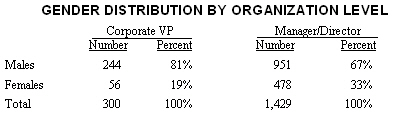
Table 1

Table 1 shows the results of the categorization process. The data does not answer the question of why there is a proportional discrepancy between genders. It is probably due to a combination of causes. For example, people at the Corporate VP level probably began their careers in the 1960s and 1970s. A lower proportion of females entering a career tract in 1970 would translate into fewer female Corporate VPs today. In addition, these females had to overcome cultural barriers to advancement. In other words, the pioneering females of the 1970s and 1980s had a harder row to hoe than their male counterparts. This may have caused a disproportionate career casualty rate.

There may have been other factors. However, the situation seems to be trending toward equality. The 33% of females in the Director/Manager role will undoubtedly migrate to the Corporate VP level in future years. When they do, the proportion of female Corporate VPs will rise.

The roughly equal proportion of males and females in colleges today suggest that the process is continuing. People graduating today will be entering management ranks in 5 to 10 years. As they do a rough gender balance will begin to appear in the corporate hierarchy. The process is rather like environmental remediation. It takes time for native grasses to displace cultivated growth. It happens over time, not overnight.

The inevitability of the process is not at question. The real question is whether females are bringing with them an entirely different approach to organizational conduct. If they are it could foretell a fundamental shift in our business institutions. If they are not, it probably means a simple strengthening of our institutions. Making full use of an unused half of the human population would be bound to elevate the standards of the “average” executive.


GENDER AT THE CORPORATE VP LEVEL
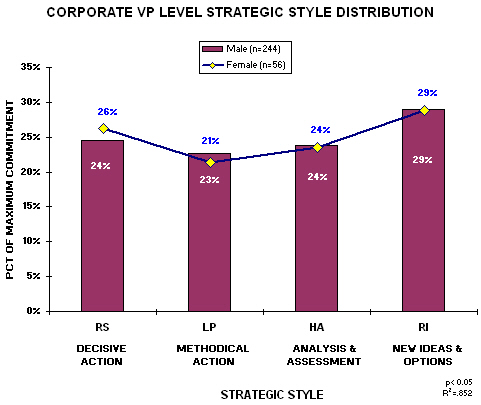
Graphic 1 shows the distribution of male and female Corporate VPs across all of the "I Opt" Strategic Style dimensions.

Graphic 1
A glance at the profile of males and females suggests that both genders are virtually identical in their overall approach. A statistical test confirms that there is no significant difference between the genders. If there is a bias in hiring, retention and promotion it does not extend to the way issues are approached. On average, both genders are focused on gathering the same level of information (input), tend to issue the same kind of response (output) and engage the same steps (process) as their male counterparts (e.g., degree of risk, goals, use of power, etc.).

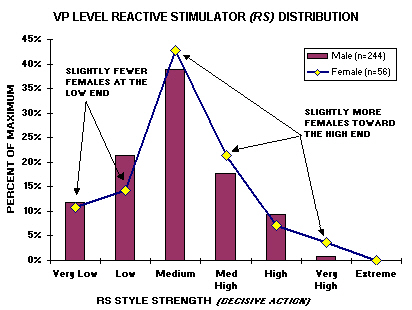
There are slight differences that do not rise to the level of statistical significance but are suggestive. One is the kind of action females at the top of firms are likely to take. Graphic 2 shows the distribution along the decisive (RS) and methodical (LP) action dimension.

Graphic 2
CORPORATE VP ACTION ORIENTATION

While certainly not definitive, it appears that there is a bit of a tendency for these pioneering females to adopt something of a forceful, quick paced posture (RS). They are also a bit less inclined to use a deliberate, careful and risk averse stance (LP). This posture, if it is "really" in the distribution, would serve to set them apart and probably help break through the glass ceilings in place during the 1970s and 1980s.


GENDER AT THE DIRECTOR/MANAGER LEVEL
Graphic 3 shows the strategic style distribution of “up and comers.” These people likely began their careers in the 1980s and 1990s. The females in this group benefited from the work of the pioneers who blazed the trail. The differences between genders are so small that percentages had to be expressed in tenths to distinguish them.

Graphic 3

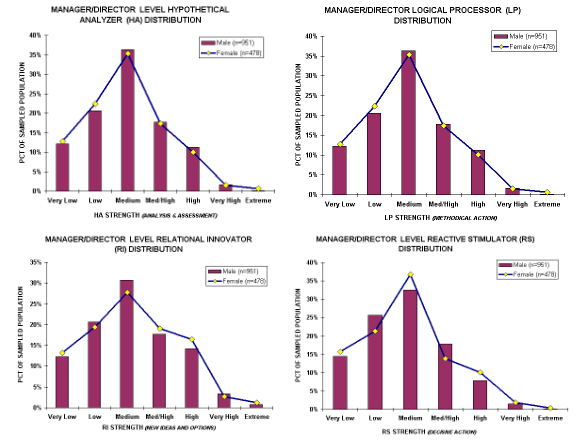
For all practical purposes the genders are indistinguishable. The correlation between the genders is 100%. At least in terms of the way the two groups approach the issues that they confront, there is no gender difference. Even more impressive is to look at the two groups in terms of the strength with which they subscribe to each individual style. This is shown in Graphic 4.

Graphic 4
DIRECTOR/MANAGER STYLE STRENGTH DETAIL
Not only are the averages virtually identical, but the distribution of style strength between the genders is identical. Literally as well as figuratively, corporations appear to be applying exactly the same criteria to males and females in terms of how they are expected to process the information that they use in the discharge of their responsibilities.


GENDER SUMMARY
On an aggregate basis, the data suggest that a corner has been turned. The likely outcome is that the business institutions of American society will be strengthened as a result. There have been no “concessions” made at an information processing level for females entering the executive ranks. This means that more talent will be competing for high levels. The people “making the cut” are likely to be, on the average, of higher quality as a result of this more intense winnowing process.

Does this mean that there is no difference between males and females? Of course not. There are real gender differences in terms of physiology, chemistry and cultural factors among many other things. These differences are likely to cause a sensitivity to different variables than might be visible in a purely male hierarchy. However, those variables will be run through exactly the same process as a male would apply had they been sensitive to those variables.

This last factor could provide another basis for improvement of the American business institutions. These added variables are just as real and important as those visible to males. Introducing them into the equation is likely to produce outcomes that are even more completely optimized for the society to which they will be applied.

This analysis was based on hard data. It was collected for other purposes and thus contains no collection or interview bias. The results of this analysis can probably be trusted.

“Vive la difference! Similitude de La de Viva!”


Sunday, October 01, 2006

CEO Insights - October 2006

The "I Opt" profile of the average CEOs should be of no interest to an existing CEO. Their way is the "right" one. It got them to the pinnacle of the firm and will likely serve them well in that capacity. The CEO's approach should matter to those who need to engage the CEO, who advise him/her or who aspire to be a CEO. For these people this knowledge can be vital.

Professional Communications, Inc. (PCI) has a large database that includes CEO "I Opt" scores. CEOs have been contrasted to other levels in the firm in earlier research blogs. This blog looks at how different CEO’s are from each other.

THE AVERAGE CEO

Graphic 1 shows the average of the 98 CEOs in the "I Opt" database. The average CEO's interest appears to center on producing creative options and on acting to secure them.


Graphic 1
The average CEO’s RI (Relational Innovator) style is dominant. It is geared to plotting a course for the firm. The CEO seizes on new insights and explores what they might mean to the firm. How a new insight might fit into the business system is quickly outlined. A collegial atmosphere tends to surround the CEO when operating in this mode. The CEO is open to changes, modification and elaboration. A vision of what might be is being created.

Not every issue yields to the RI strategy. Even when it does, the creative process will sooner or later be exhausted. The CEO then shifts to their next most favored strategy, the Reactive Stimulator (RS). At this point talk is over. It is now the time to "do." The CEO's focus changes from what to do to when it will be done. Collegial give and take is replaced by authoritative direction. Milestones are set and commitments sought. Focused action is the CEO’s interest.

The world is not linear. Neither is the CEO's approach. They bounce back and forth between their preferred strategies. The combination catalyzes the adjustments the firm needs to navigate an ever-changing environment. The average CEO is a creative “doer.”

The “take home” from the above is that if you want to engage an average CEO, bring something creative to the table. Attach some kind of action proposal (RS) to it and be ready to move if it is accepted. Having some analytical HA material available explaining why a course has been selected is probably advisable but it should not be stressed. The least important thing is laying out exactly how things are to be done.


NON-PROFIT CEOs
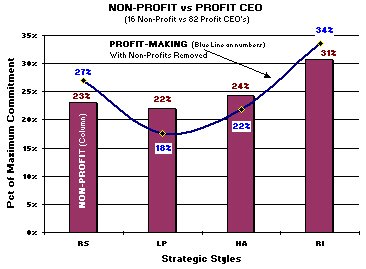
Sixteen of the 98 CEOs in the "I Opt" database head non-profit or government (state and federal) agencies. Non-profits face more nebulous missions than firms in the profit-sector. There is no clear “bottom line.” Market feedback is slower and less clear-cut. These differences reflect themselves in the CEO’s profile as shown in Graphic 2.

Graphic 2
Non-profit CEOs favor the RI (creativity) strategic style but with a bit less intensity. Less defined goals make figuring out how a new idea “fits in” more difficult. A slower market feedback means less reliance can be placed on decisive action (RS). Too much damage can accumulate before a problem is known. In response the secondary strategy shifts to the analytical HA. Initiatives are more likely to be analyzed before being acted upon. Getting it done right is more important than being first to market.

All of the secondary strategies lie close together in strength. This is testimony to the nature of mission. The advantage of one strongly dominant secondary style is less clear cut. Like other CEOs the non-profit CEO is plotting a course in an uncertain environment. They are doing it more cautiously because they have to.

The “take home” from this mini-analysis is that the non-profit CEO can be engaged with creativity. However, the process of deciding what (if anything) to do will be longer. There simply are more things to consider. The balanced secondary styles mean that they may appear more “reasonable” than their profit-sector equivalents. They will seriously consider a wider range of proposals. The cost is elongated discussion and slower decisions.

Keep in mind this is mini-analysis is based on averages. There are non-profits with explicit goals and fast feedback. This means that there are non-profit CEOs who use strategic patterns similar to the profit-making sector. But these people will not be the typical non-profit CEO.


LARGE FIRM CEOs
Larger firms tend to face complex issues and their decisions usually involve more stakeholders. The 82 profit-sector CEO’s in the database can be divided by size. Twenty-three have revenue of over $100 million. This should result in a different strategic profile—and on average it does.

Graphic 3
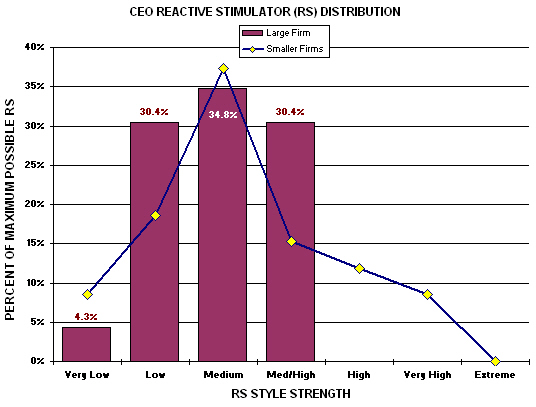
Graph 3 shows the style distribution with the non-profits excluded. Large-firm CEOs appear less willing to take decisive action and more inclined to subject initiatives to analysis before acting. Graphic 4 shows that smaller firms are more likely to have CEOs who are prepared to act more aggressively. Large firm CEO's are also prepared to act but none occupy an extreme position. This reduces the overall RS average of large firm CEO shown above in Graphic 3.

Graphic 4
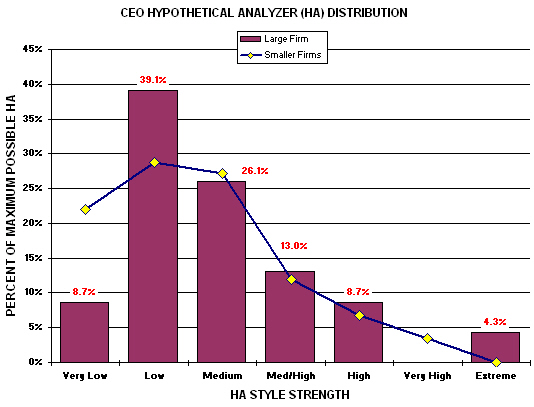
The analytical HA offers a similar story but on the other side. Graphic 5 shows that the large firm CEOs are seldom found at the "very low" HA level. They have been shifted to the "low" level. This move has the effect of increasing the large firm CEO's average HA score. In other words, the higher overall HA is due to fewer people in the very low category rather than to more people in the higher ones.

Graphic 5
The difference in large and smaller firm CEO profiles lies in the extremes. Large-firm CEOs are inclined to cluster in a band in the middle of the spectrum. It is likely due to the nature of the decisions being made. Complex decisions combined with multiple stakeholders probably favor moderate people in the CEO chair of larger firms.

Strategies that work for the CEOs of smaller firms are likely to be transportable to larger firms. The CEOs are equally interested in creative ideas. Their response to an initiative is likely to be more moderate but of the same character. In terms of decision-making information flows, what works at one CEO level will probably work at another.


BANTUM FIRM CEOs
A 27-person segment of the profit-sector database consists of firms with less than $10 million in revenues. These firms live in a more precarious world. Their leaders might be expected to be sensitive to different information flows than their larger cousins. This is not the case.

Graphic 6
The CEOs of the smallest firms look just like their larger brethren in terms of the structure of their information processing profile. They place highest value on creativity (RI) and are quick to action (RS). But there is a difference and it lies in the detail.

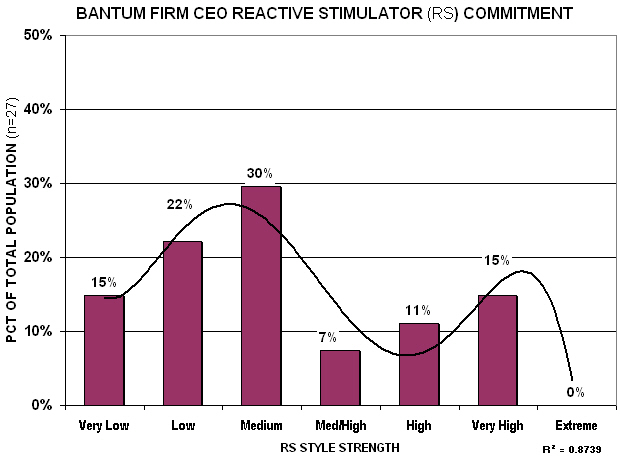
Graph 7 shows that the RS component is not linear. There seem to be two kinds of bantum firm CEOs. One set is relatively conservative in the use of decisive action. The other is aggressive. This may be due to the variety of different businesses (i.e., from janitorial firms to system integrators) in the sample. Or it may be that different strategies are equally viable. The charts do not answer this question.

Graphic 7

The CEOs of the smallest firms also put less stock in creativity (RI) than do both larger firm and non-profit CEO's. They average to about the same overall level. However, highly creative CEOs are more likely to be found in the bigger rather than smaller firms (see Graphic 8 "high" category). Thin resources may focus smaller firms on more certain strategies. Whatever the reason, it is less likely that a bantum firm CEO will be engaged by creative possibilities than will the CEOs of larger firms.

Graphic 8

The "take home" from this mini-analysis is that smallest firm CEOs are more variable than are their larger firm counterparts. Some will move VERY decisively but most will assume a more cautious posture. Creative options will be of some interest but are less likely to engage the bantum firm CEO.


SUMMARY
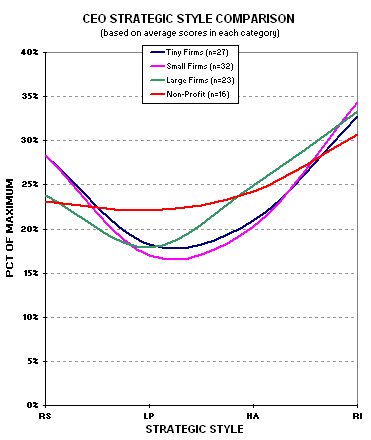
Graphic 9 shows an overall family resemblance among CEOs of all types. The non-profit CEO is most unique but still echoes of the profit-sector CEO profile.

Graphic 9
The reason for the similarity probably lays in the common role the CEOs fill in any organization. Their job is navigating the future. Standard practices and existing methods are in the competent hands of others. The CEO role is to identify opportunities for meeting the conditions of a business environment that does not yet exist. The creative RI strategy is best suited for that purpose. It is likely that CEOs either develop or are selected for their strength in this area.

Once a course has been plotted the CEO role is to cause the firm to follow it. This responsibility is best served by the decisive and action oriented RS style. The posture is tempered in the case of large and non-profit CEOs in favor of the analytical HA style. It is likely that the most important factor in this shift is the influence of stakeholders. The absolute magnitude of decisions attracts and motivates the large firm CEO's stakeholders. Satisfying this wider mix of interests likely results in a more tempered posture.

The more nebulous mission of the non-profits has the same effect. Here stakeholders probably attempt to "bend" decisions in favor of their own interests. Without a definitive "bottom line," analysis (HA) is the only tool available for sorting out the interests' relative to the issues.

Smaller firm CEO's in the profit-sector are the least restricted of the group. They have fewer stakeholders. This means that the decisive RS will be evidenced in visible behavior more quickly. The level of creative RI may be less pronounced (in terms of distribution) but will be visible faster. Hence the smaller firms will be seen as being more nimble and more creative than their larger-firm counterparts.