Sunday, June 18, 2006

Consultant Profile: Getting the Gig

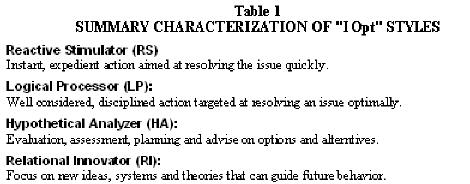
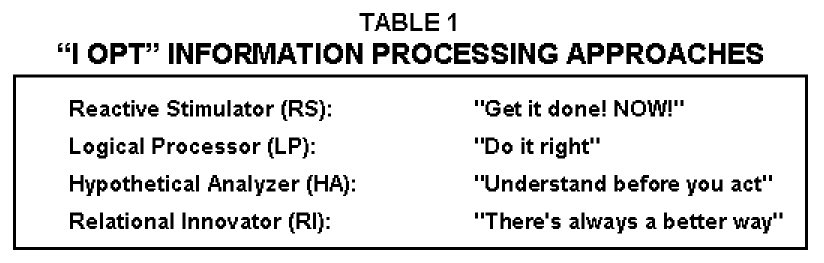
Organizational Engineering (see www.oeinstitute.org for more information) looks at the world through an information-processing lens. The basic idea is that the world can be navigated in a variety of ways (e.g., there is more than one way to get to Chicago). Different objectives favor different strategies (e.g., the fastest road vs. the most scenic). These "I Opt"® strategies can be informally summarized as:

Professional Communications, Inc. (PCI), the creator of "I Opt" (see www.iopt.com for more information), maintains a large database of “I Opt” scores. This article uses this data to explore the characteristics of professional consultants.

BASIC CONSULTANT PROFILE

Consultants provide subject matter expertise. Clients contract with them to solve problems. Normally, the relationship is short-term. Once the issue has been addressed, the consultant moves on. The similarity in services offered, the nature of client relation and duration suggest that there will be a commonality in “I Opt” styles among consultants. This commonality is outlined in Table 2.
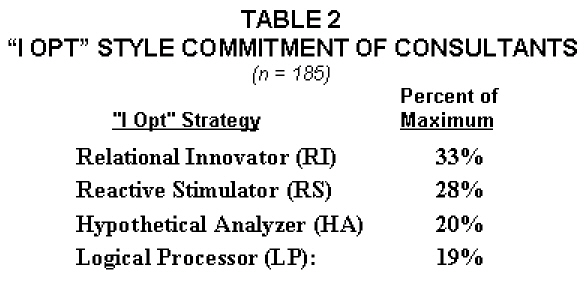

Not surprisingly, the idea-oriented Relational Innovator (RI) style is favored. Consultants are usually called when there is a vexing problem. The "usual" solutions have already been tried. The consultant is expected to bring in new ideas, options, and approaches. Consultants who consistently display this creative ability will be favored—and they are.

The strong secondary position of the RS might be somewhat unexpected. This "get it done" posture makes sense, however, when you consider how consultants are paid. They typically work on an hourly or daily basis (at the time of this writing, about $2,500 to $3,000 per day for a "typical" consultant). Clients pay for results. Analysis, evaluation, and assessment (an HA posture) do not usually qualify as the “results” being sought.

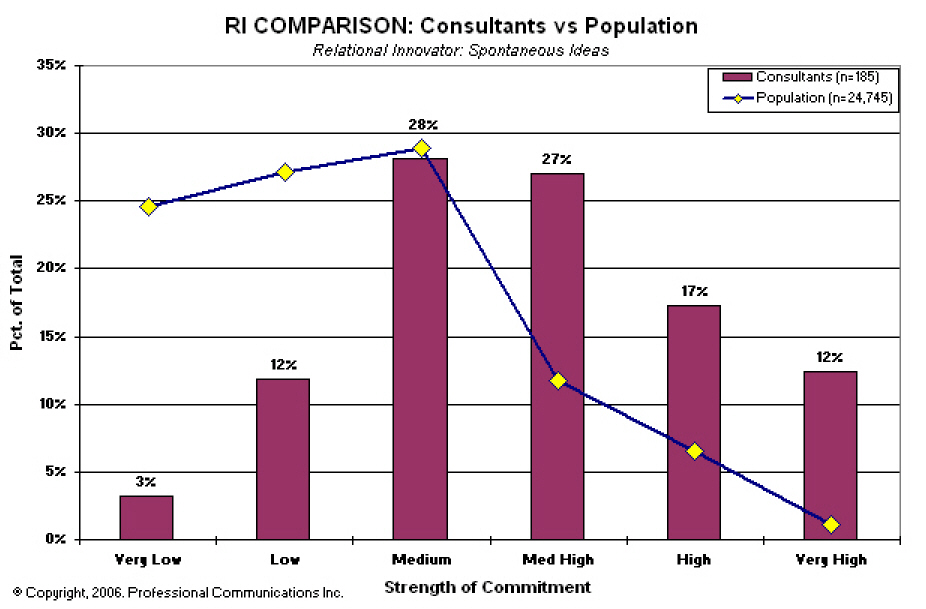
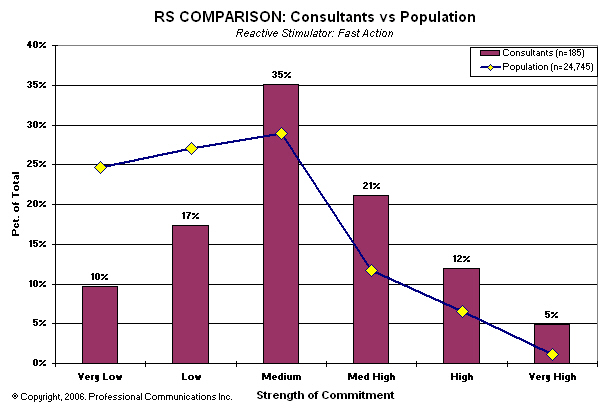
Comparing consultants to the general population highlights the uniqueness of the consultant's approach along both the idea and action dimensions.

FIGURE 1
RELATIONAL INNOVATOR (RI)
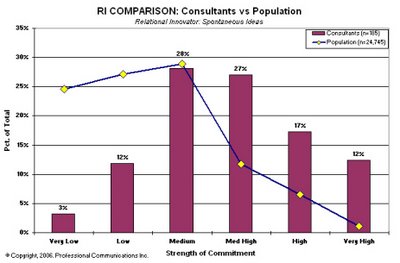
FIGURE 2
REACTIVE STIMULATOR (RS)

There are consultants in every strength category for both RS and RI. However, the degree of difference with the general population is striking. The general population dominates the distribution at lower strength levels. The consultants dominate at higher levels.

Consultants are not always warmly received by the staffs of the client with whom they work. The difference in basic approaches to issues may be a basis for this result when it arises. From the perspective of the general employee pool, the consultant will not be approaching the issue in the "right" way. Compound this with the perceived high compensation (they do not see the unpaid hours) and a bit of tension is understandable.


A take home from the above observation is that a consultant should not expect affection from the people with whom they work in solving corporate issues. Some among the staff will see value in the approach. Most will not. Similarly, the client commissioning the work should expect to hear grumbles from the staff. The measure of success is the solution of the issue. One price of this solution may be a bit of disquiet among the lower levels.


INTERNAL vs. EXTERNAL CONSULTANTS
The "I Opt" database has a sample of 67 people who have been identified as internal consultants. Like external consultants, these people tend to be project oriented. They also move in and out of the various parts of the firm. The parallel between the work of internal and external consultants is strong. On its face, we would expect internal and external consults to approach issues in roughly the same manner.

Figure 3 shows the average strategic style strength of internal and external consultants. The similarity in style profiles is obvious, as are the differences.


FIGURE 3
EXTERNAL vs. INTERNAL CONSULTANTS

STRATEGIC STYLE COMMITMENT
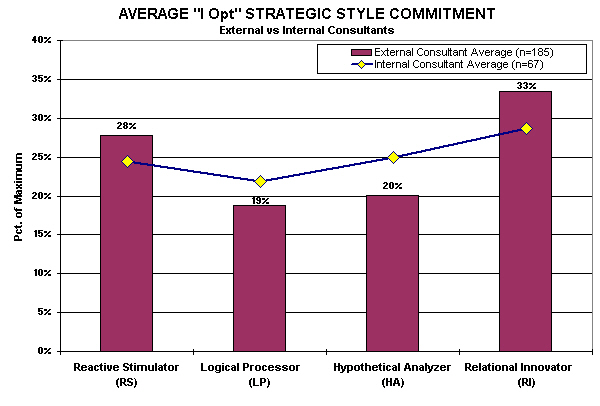
Overall, internal consultants have less of a commitment to the spontaneous RS and RI styles. These differences are academically significant (RS p<.05; RI p<.01 using the Mann Whitney U Test). Internal consultants also show a higher commitment to the disciplined HA and LP styles. The HA meets the academic standard of significance (HA p<.05) while the LP fails. Overall, it is fair to say that these differences are probably not due to pure chance.

Internal consultants will tend to be somewhat more disciplined. Their higher scores in HA suggest the greater use of disciplined thought. The higher LP suggests more stress on methodical execution. This posture limits the strength of the unpatterned RS and RI styles. The more discipline, the less spontaneity. The tradeoff cannot be avoided.


A moment's reflection suggests a possible reason. Internal consultants are paid a salary. "Real" consulting gigs are sporadic. External consultants leave. Internal consultants must find a way to stay busy inside the firm. Planning/analysis (HA) or executing established processes and programs (LP) are inviting activity candidates. These are low risk activities that keep you out of trouble as you await the next gig. As an internal asset, it is usually a good idea to save your ammunition for the times when you will need it.


The take home from this mini-analysis is that internal and external consultants are both similar and different. People can readily move between the categories. Client firms often hire their external consultants. Internal consultants often move into an external role. Both are viable strategies for the average consultant.


The mini-analysis also suggests the difficulties both types of consultants will face in a move to the other side. Internal consultants will tend to over invest (the HA and LP effects) in preparation. This will delay the point at which they will get traction. External consultants will tend to be a bit too aggressive. This posture will likely cause some political issues. These will delay their full integration into the firm. Both internal and external consultants will have crosses to bear if they move to the other side
.


CONSULTANTS vs. HIERARCHICAL LEVELS
Consultants must sell themselves to get the gigs on which they depend. A first principle of sales is to “mirror” the prospect. The closer their “I Opt” style matches their prospect, the more likely it is that they will “connect” with them. That connection is the first step on the path to securing a new client.


The higher the hierarchical level of a prospect, the more likely it is that they will be able to sign the contract to solidify the gig. Table 3 shows the average “I Opt” style commitment of people at various hierarchical levels who might be able to “ink” a contract.
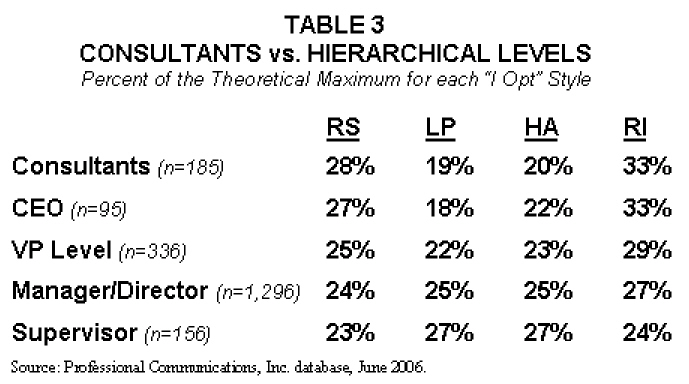

Table 3 shows that the average consultant most closely matches the profile of the average CEO. A correlation coefficient of .98 confirms the common sense notion that if a consultant can get the CEO, they should. The reception is likely to be warm. They are birds of a feather.

The problems a consultant is brought in to resolve, however, usually exist at lower levels. The normal state of affairs is that the consultant must traverse multiple levels before finding someone who will actually sign a contract. Figure 4 gives a picture of the "I Opt" style differences that exist at the various hierarchical levels.

FIGURE 4
CONSULTANTS vs. HIERARCHICAL LEVELS
Percent of the Theoretical Maximum for each “I Opt” Style

The average values shown in Table 3 are plotted in Figure 4. The match between the average consultant and CEO is obvious. As you move down the hierarchy, the structure of the “I Opt” style pattern systematically changes. As you move down the hierarchical scale, the middle of the bands in Figure 4 flex upwards. This section of the chart represent the commitment to the disciplined HA and LP styles.


At lower levels, facts and logic dominate—prospects want to be shown that your proposal is likely to work. As you move up the scale, facts and logic become less important. The creativity of your ideas and a willingness to act quickly becomes more important. The risk is that the consultant will not recognize that the game is changing as a proposal migrates up the chain.


Entry level work usually involves appeasing lower level executives. Elaborate and detailed presentations are in order at these levels. These productions usually require a lot of work. The consultant will be tempted to amortize his/her investment by carrying it to the next level. The higher the jump, the less effective will be the “let’s reuse what we have” strategy.


The take home from this mini-analysis is the consultants must be willing to invest. Proposals must be retooled if more than one level is involved in getting a gig. The work done at lower levels becomes backup. It might be needed because not everyone at a particular level is average. However, as you migrate up the chain, increasing effort should be invested in principles, concepts and action options. Less should be invested in “why” and “how.”


SUMMARY
The Organizational Engineering database has enabled us to make some useful observations on consultants both internal and external. These include:
  1. Consultants are not like everyone else. An information-processing strategy leaning toward spontaneity in ideas and action is favored.

  2. The higher you go up in the hierarchy, the more likely it is that the consultant will “connect” with the prospect. The often repeated advice to “shoot for the top” is good counsel.

  3. If you have to navigate different levels to get the contract inked, expect to invest in retooling your proposal. Attempting to save work by reusing a presentation at different levels may be a formula for failure.

  4. If you get the gig, prepare the client for a bit of discord. On the whole, the internal staffs may not warmly receive your efforts. You are going to approach the issue differently than they might prefer. The reason you are there is to offer a different approach. A bit of tension is a natural outcome of this condition.

  5. Going over to the other side is a viable strategy. The external consult has an exposure in being a bit too aggressive. The RS and RI strategies that kept you alive when on the outside can be a source of political friction when you are on the inside.

  6. The internal consultant moving to the outside is likely to spend a bit of time getting traction. There might be a tendency to over-invest when preparing. This time would be better spent in marketing. There might also be a bit too much reliance on traditional, proven methods. People hire you because you bring a new perspective. Pulling out too many well-worn tools diminishes one of your principal competitive advantages.
This mini-analysis is also a practical demonstration of the value of the “I Opt” information-processing approach to analyzing behavior. A brief orientation, a few simple statistics and a small number of graphs provided “take home” observations that are worth taking home.

The websites www.iopt.com and www.oeinstitute.org can orient you to the standard tools and their practical applications in the real world. This Blog demonstrates that the data collected in those applications can have a value in and of themselves. The “I Opt” information-processing approach is able to yield continuing, as well as, immediate benefits.

Wednesday, October 26, 2005

Leadership Development

Professional Communications Inc. is the creator of "I Opt" technology (www.iopt.com). The firm has accumulated a large volume of data on real teams functioning in all areas of society. This blog is an effort to convert some of this data into information of value to people involved in leadership development


SHORT-RUN LEADERSHIP BEHAVIOR

Dr. Ashley Fields’ 2001 Doctoral Dissertation investigated the “I Opt” strategic style preferences of leaders.


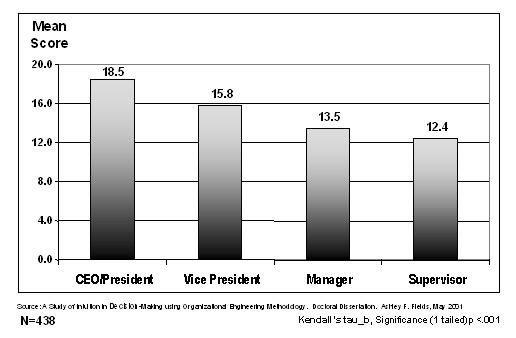
Using Professional Communications’ Summary database, Dr. Fields found that the Relational Innovator (RI) was the strategic style most characteristic of leaders. A portion of his findings are shown in Graphic 1.

Graphic 1
Relational Innovator (RI) Scores by Organizational Rank
(Click here to view entire dissertation in Acrobat)

Dr. Fields' discovery was more important than just finding that the RI style dominated. He found a “stairstep” function—the higher the organizational level, the higher the level of the Relational Innovator (RI) style. This finding suggests:

Leadership development should focus on developing a
RI capacity among its pool of all future leaders at all levels.

Another implication of the “stairstep” is that the optimal level of RI is not the same for every position. The levels of RI appropriate for a CEO is not the level that is optimal for a supervisor and vice versa. This means:

Leadership development will have to align its offerings
with the level of the people it is developing.


Dr. Fields’ findings are an important first step. The next step is to focus on the longer-term behaviors of leaders.


LONG-RUN LEADERSHIP BEHAVIOR

Most issues of significance involve a series of decisions. Even if the first decision yields to the RI approach, it is very unlikely that the next decision in sequence will succumb to the same strategy. This is where a person's secondary style comes into play.

A secondary style is the next most likely to be used where the primary style does not apply. The combination of the most and the next most used style will come to characterize behavior. This concept is captured in the "I Opt" variable called "Strategic Pattern."

Strategic patterns are combinations of behaviors connected by a commonality in either method (input) or mode (output) strategies. Patterns usually (but not always) combine a person's primary and secondary preferences. Table 2 defines the "I Opt" behavioral patterns.


I conducted a study to identify the strategic pattern most favored by leaders. Our Hierarchical Database contains information on 919 teams. Using this database it is possible to identify the strategic pattern (primary and secondary style) that most differentiates the leader from the remainder of the team. The results of this study are shown on Graphic 2.

Graphic 2
Leadership Strategic Pattern Distribution in Teams


Changer is the dominant pattern.
This finding suggests that the current social environment favors a strategic pattern based on innovation, speed, experimental implementation, and so on. The cost of this approach—suboptimal solutions, high failure rate, and organizational disruption -- does not appear high enough to offset the advantages of the strategy. The implication of this finding is:

It is not enough to focus exclusively on the RI (idea) capability.
A secondary RS
(quick action) capacity must also be developed.

The Changer Pattern is not a universal "good."
Not every leadership position favors the Changer pattern. Both the Perfector and Performer positions are also strongly represented. An examination of the database suggests that these patterns are probably functionally determined. For example, sales management seems to favor the Performer pattern (“Get it done!") while university level academicians lean toward Perfector ("Let's think it through"). The implication of this finding is:

Developing effective leadership is situational.
Leadership development must be sensistive to the leader's area.

The least represented pattern, Conservator, has its place.
This pattern seems to be found in areas where accuracy is more valuable than innovation. Applied science leaders as well as Certified Public Accountants show a greater representation of the Conservator pattern. These high accuracy areas can be vital to business success. The implication is:

Leadership development must create a respect for different
leadership strategies. If everyone tries to be a Changer, the
organization will probably suffer.


GLOBAL IMPLICATIONS

The central implication of the findings is that a "one size fits all" approach to leadership development is probably ill-advised. Leaders targeted toward sales management need a different approach than those targeted toward banking. To be fully effective:

Leadership development must be sensitive
to the nature of the leader that it is trying to create.

Another implication is that normative models (models based on a survey of opinions of leaders in a specific area) probably incorporate a mixture of human information processing patterns and industry specific variables. This probably accounts for the 171,612 books on leadership currently available on Amazon (as of October 25, 2005). This suggests:

Information processing preferences can be
treated separately from local variables
.


Both elements are important in leadership. Treating each separately makes teaching easier and learning more effective. Combining the two elements can create a tangle of permutations that can be hard to put into actual practice.

A final implication is that there is much more to leadership than indivdual skills. Leaders must work together if the goals of a firm are to be fully realized. Since leaders are not clones, it can be expected that the information-processing styles being used will clash with as well as complement each other.

Leadership developement should anticipate this condition. People typically believe that their "way is the right way." That is why they use it. They have to be shown that other strategies have value and can be meshed to create a whole greater than the sum of the parts. This suggests that:

Leadership development efforts should include sessions
where the relative advantages and vulnerabilities

of each pattern are made visible.


This blog is not an attempt to lay out an academically definitive theory of leadership. It's intent is only to outline some of the obvious implications flowing from the data on actual teams functioning today in the "real world." If it stimulates the thinking of people involved in leadership development, it has served it’s purpose.


Tuesday, February 22, 2005

"I Opt" Validity: Validation Explained in English

Clients and prospective clients invariably ask about the validity of "I Opt." Since "I Opt" (www.iopt.com) is the only tool in Organizational Development that I know of which has been FULLY validated this question is always welcomed.

My typical response is to send them to www.oeinstitute.org and have them read the full study. Recently, I went back to the study. As I read it, it occurred to me that the study presumes the reader has a knowledge of statistics beyond that which most of my clients possess. This Blog is meant to define the dimensions of validity in a language that anyone can understand.

MOVING FROM SPECULATION TO "FACTS"

In final analysis, validity is an argument about whether your theory can be trusted. Validity dimensions are just points of evidence that you use to support your point of view on a subject. In the case of "I Opt" that subject is a theory of the behavior of groups and individuals.

A theory is just a statement of "what causes what." Theory is what you use to understand life. Theory is the basis on which you diagnose a situation. Theory is the foundation on which you base your recommendations that will change the lives of others. Theories are important.

Like everything else, theories come in gradations. At the bottom is speculation. This is an opinion and everyone has them. Like any other commodity with unlimited supply, they are not worth much. At the top are "facts." These are things whose truth is unquestioned by any reasonable person. Facts are usually in short supply and their price is the work you have to do to establish their truth. Most of the things we think we know exist somewhere between speculation and facts. Validity is a tool we use to move up on the scale toward "fact."


DIMENSIONS OF VALIDITY

CONTENT: This means that the components of the tool you are using (e.g., statements in the "I Opt" Survey) relate the theory in a meaningful way. If you do not have Content Validity you could be trying to measure distance with a thermometer. You will never know. "I Opt" has a Nomological Net. This tracks each "I Opt" response directly back to the underlying theory. The Net gives assurance that the "I Opt" tool is measuring what the theory is talking about.

FACE: The respondent (e.g., person who took the "I Opt" Survey) agrees with the diagnostic. This is often dismissed by the academicians. However, from a practitioner's standpoint, it is the most important measure of validity. If you do not have Face Validity you will be arguing with your client about the "truth" of the diagnostic you are trying to give. It is a great way to lose a client. "I Opt" has 99%+ face validity.

CONSTRUCT: This gives assurance that the measurement is right. If your tool measures literacy, a positive result would indicate that the respondent can read. If your tool says that the person can read and he cannot, you have measured the wrong thing. "I Opt" has a statistical significance in this dimension of p=.0152 . In other words, there is less than a 2% chance that this positive result could be found by chance. Academia is a bit more relaxed and usually takes 5% as their standard.

CONVERGENT: This dimension of validity assures you that things in the real world that should relate to each other do relate. For example, a tool that tries to measure "creativity" should be directly related to another tool that measures the frequency of novel responses. If they do not directly relate, you have probably measured something other than "creativity. " The "I Opt" validity study tested this along four dimensions and each met or exceed the academic p< .05 (less than 5% probability that the results are due to chance) standard.

DISCRIMINANT: This dimension of validity assures you that things in the real world that should not relate to each other do not. For example, the "styles" of people in R&D, Customer Service and IT would be expected to be unrelated. The different demands of these different areas would seem to require different "styles." If it turned out that your tool measured the same style mix in these different areas you probably do not have a style measure that can be used in work allocation. "I Opt" met the discriminant validity test with a significance level of p< .000000000000000000000000000000000001 or that there is less than 1 chance in a gazillion that this result was due to chance.

CONCURRENT:
Concurrent validity says that the results (e.g., "I Opt" diagnosis) relate properly to other things outside of the theory being tested. For example, if someone scored high on an "introvert" scale in MBTI, we would not expect him or her to be found frequently dancing on tables with a lampshade on their head. If your tool scored a group as having high introversion, and someone else measured them high on a scale of "table dancing", you probably failed this test. "I Opt" has an inaccuracy rate of ZERO in its alignment with other measures. In other words, it fits with other things that it should fit with.

PREDICTIVE: This validity test says that the future can be predicted in a testable way. In other words, you should be able to foretell the future before that future happens with a high level of accuracy. "I Opt" was measured for six consecutive predictions and the worst that it did was p<.01 (less than 1% probability that the results are due to chance). On other tests "I Opt" registered an INACCURACY rate of ZERO. In other words, what "I Opt" says will happen does happen.

CONCLUSION: This test asks if the results are reasonable in the “real world” (sample size, statistically stable, etc.). In other words, can the results be trusted. For example, if you tested your tool on 30 students you may be able to meet all of the validity measures above. However, would you trust your results if that tool were applied to all of the million employees of WalMart? I would not. Or, you may apply parametric statistics (i.e., tests that use the normal curve) on data that has not been tested for "normality." You could argue the statistics are "robust." The question is if they are robust enough. No one will know. "I Opt" demonstrated its Conclusion Validity by using a large sample (over 14,000 people), enlisting 50 mature experts (VP's, Ph.D.'s, Directors of OD, Consultants and etc. It did not use inexperienced students) and applied rigorous statistical assessments. What this tells you is that your validity tests really mean something in practice.

RELIABILITY: This measures says that if you did it again, you get the same result. This is not a measure of validity as much as a measure of repeatability and consistency. "I Opt" again met and exceeded the academic standard.


SUMMARY

Validating a theory is expensive and time consuming. The investment only makes sense when you are working with a theory that you expect to be employed widely and applied in important areas of life. For example, if you are working on a program that will only be applied in your firm you can probably forgo validity tests. You can tell pretty quickly if it meets your needs and then figure out if it is worth the investment.

However, validation is a baseline requirement if you are offering a product that will:
(1) be applied to people you do not know
(2) in areas that you are unfamiliar and
(3) over timeframes that extend beyond your lifetime

Here you are asking people to put their faith in your theory and use it to alter the lives of other people based on its "truth." Under these conditions the time and expense of validation would seem to be a minimal requirement that should be provided by the builder and demanded by the buyer.